
Band Saw Blade Guide
Meat Band Saw Blade Guide — TPI, Blade Type & Thickness Explained
Choosing the right meat band saw blade directly affects cutting speed, product yield, blade life, and operator safety. This guide covers every decision point: what TPI means and how to choose it, the difference between standard and scallop blades, and when to use .022 versus .025 inch thickness. Whether you run a commercial butcher shop, a meat processing facility, or a grocery store meat department, the right blade for your application is a practical and cost-saving choice — not just a technical one.
Not sure which size blade your machine needs? Use the CutleryMania Band Saw Blade Cross Reference Chart to look up your machine by make and model.
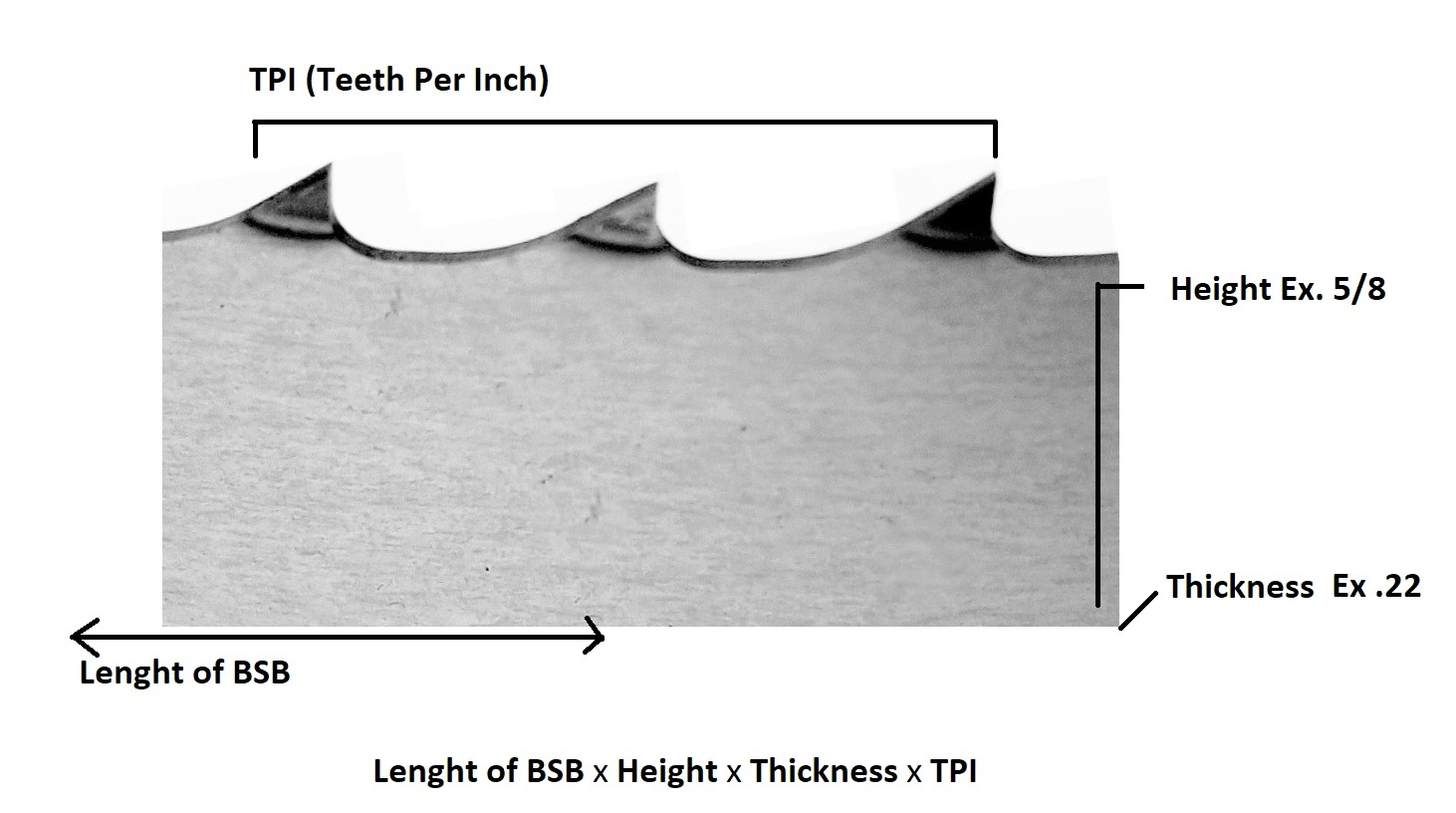
What Does TPI Mean on a Meat Band Saw Blade?
TPI stands for Teeth Per Inch — the number of cutting teeth in every inch of blade length. On a meat band saw, TPI is the single most important specification for matching a blade to the product you are cutting. A lower TPI means fewer, larger teeth that cut faster and more aggressively. A higher TPI means more, smaller teeth that cut more slowly but produce a smoother, cleaner surface.
For most commercial meat cutting applications, the choice comes down to 3 TPI versus 4 TPI. Understanding the difference helps you select the right blade for bone-in versus boneless work, frozen versus fresh product, and high-speed production versus retail-quality presentation cutting.
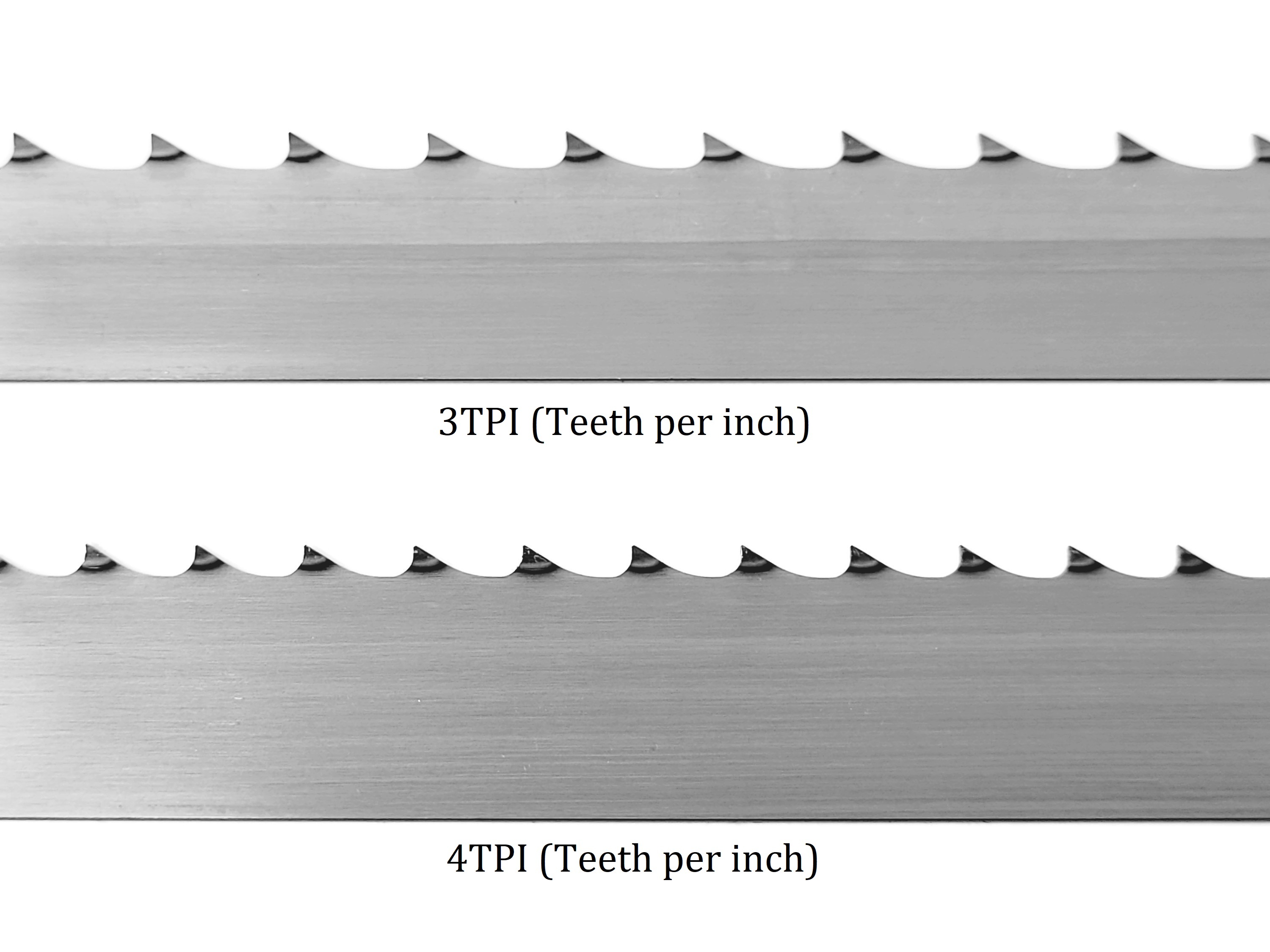
3 TPI Meat Band Saw Blades — Best for Bone-In & Frozen Meat
A 3 TPI meat band saw blade is the most widely used option in commercial butcher shops, meat processing plants, and grocery store meat departments. With three teeth per inch, it cuts aggressively through dense material — including bone-in beef and pork, frozen meat blocks, ice blocks and large primal cuts — without binding or slowing down. The wider tooth spacing allows bone chips and meat debris to clear the cut quickly, reducing heat buildup and extending blade life under heavy use.
The 3 TPI blade is the right choice when production speed matters more than cut-surface finish. For high-volume bone-in processing — breaking down beef primals, portioning pork loins, or cutting through frozen product — it is the standard blade for a reason. Most commercial butcher operations run a 3 TPI blade as their everyday workhorse and switch to a finer blade only for specific finish-cutting tasks.
Best applications for 3 TPI blades: large primal breakdown, frozen meat cutting, ice blocks, bone-in beef and pork processing, high-speed commercial production, carcass breakdown.
4 TPI Meat Band Saw Blades — Best for Fresh Meat & Retail Cuts
A 4 TPI meat band saw blade produces a noticeably smoother cut than a 3 TPI blade. The additional teeth per inch reduce the bite per tooth, which means less tearing, a cleaner cut surface, and better control for smaller or more precise portions. This makes it the preferred blade for retail butcher shops where cut presentation matters, for poultry processing where clean cuts reduce waste, and for fresh meat applications where the finished surface will be customer-facing.
The 4 TPI blade is not the right tool for heavy frozen cutting or high-volume bone-in breakdown — the finer tooth pattern loads up faster under that kind of stress. But for a retail shop doing fresh beef, pork, and poultry with an emphasis on clean, consistent product, a 4 TPI blade offers a better balance of speed and finish quality than a 3 TPI.
Best applications for 4 TPI blades: retail-ready fresh meat cutting, poultry processing, smaller bone-in portions, general butcher shop use where cut appearance matters.
Scallop Meat Band Saw Blades — Best for Boneless Meat & Fish
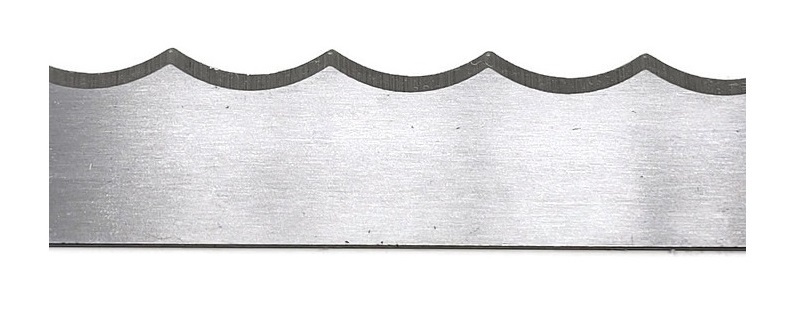
Scallop blades use a curved, wave-shaped tooth design rather than the pointed teeth found on standard 3 TPI and 4 TPI blades. This geometry reduces drag as the blade moves through meat, producing a smoother cut surface with less tearing and less product waste. The scallop pattern also runs quieter than standard blades and generates less heat during cutting, which can extend blade life in the right applications.
Scallop blades are the best choice for boneless fresh meat, fish processing, poultry, and any application where the appearance of the cut surface directly affects product value. They are not recommended for frozen meat or heavy bone-in cutting — the scallop tooth design is optimized for smooth protein, not dense or hard materials.
Best applications for scallop blades: boneless beef and pork, fresh fish processing, poultry, retail presentation cuts, applications requiring minimal surface tearing.
Meat Band Saw Blade Thickness — .022 vs .025 Inch
Blade thickness is the second major specification to consider after TPI. The two standard thicknesses for commercial meat band saw blades are .022 inch and .025 inch. Thickness affects blade rigidity, flexibility, durability, and how much resistance the blade puts up against the meat saw's drive system.
.025 Inch Band Saw Blades — Heavy Duty Commercial Use
A .025 inch blade is thicker, stiffer, and more durable than a .022 inch blade. The added thickness gives it better stability under pressure, making it the right choice for high-volume commercial cutting, frozen meat, heavy bone-in processing, and larger industrial band saw machines that operate at higher tension. The trade-off is slightly less flexibility — .025 blades do not navigate tight turns as easily, which matters more in woodworking than in straight meat cutting applications.
For commercial butcher shops and meat processing facilities that run their saws hard every day, the .025 blade typically delivers a longer service life because it holds up better under repeated stress. If you are cutting frozen product regularly, .025 is the correct choice — .022 blades can fatigue faster under the added resistance of frozen meat. However it is important to keep in mind that the thicker blade will result in more product waste, so if unsure, we often recommend starting with the .022 to see if you get good results with it first.
Best applications for .025 blades: frozen meat cutting, heavy bone-in processing, high-volume commercial production, large industrial band saws, operations prioritizing blade longevity over flexibility.
Shop .025 x 3 TPI Meat Band Saw Blades →
.022 Inch Band Saw Blades — Precision & Retail Cutting
A .022 inch blade is thinner and more flexible than .025 inch, which translates to lower cutting resistance and cleaner, more precise cuts on fresh meat. It is the right thickness for retail butcher shops, lighter commercial machines, and applications where the priority is cut quality on fresh boneless or bone-in product rather than heavy-duty durability. The thinner profile also means less product waste per cut, which matters in high-value protein applications.
If your machine is on the lighter end of commercial meat saws, or if you primarily cut fresh product without a heavy frozen workload, a .022 blade will perform well and produce a slightly cleaner cut surface than .025. For operations that do a mix of light and heavy work, many shops keep both thicknesses on hand.
Best applications for .022 blades: retail fresh meat cutting, lighter commercial machines, precision portioning, fresh poultry and pork, operations where cut-surface quality is the priority.
Quick Band Saw Blade Selection Guide
Use this reference to match your primary cutting application to the right blade combination. When in doubt, the 3 TPI .022 blade is the most versatile all-around option for a mixed fresh-cutting operation.
| Application | Recommended Blade | Why |
|---|---|---|
| Frozen meat cutting | 3 TPI + .025 | Maximum rigidity and cutting aggression for dense frozen product |
| Heavy bone-in processing | 3 TPI + .025 | Aggressive cut clears bone quickly; thickness handles stress |
| General butcher shop (fresh, bone-in), ice blocks | 3 TPI + .022 | Versatile everyday blade for mixed fresh cutting |
| Retail fresh meat & poultry | 4 TPI + .022 | Smoother finish for customer-facing cuts |
| Boneless meat & fish | Scallop + .022 | Minimal tearing, cleanest surface for boneless protein |
| High-volume industrial processing | 3 TPI + .025 | Best durability and throughput under continuous heavy use |
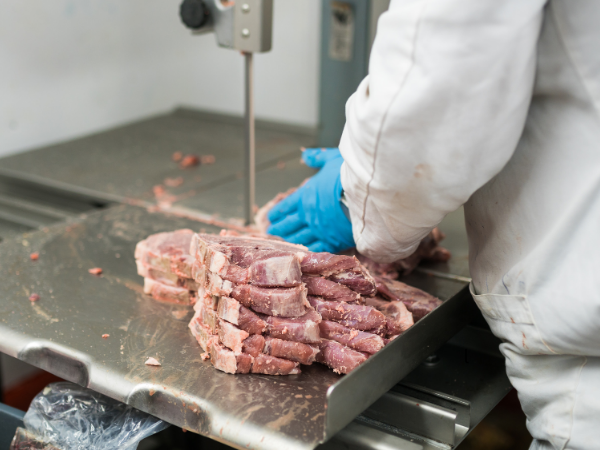
How to Measure Your Meat Band Saw Blade
Every meat band saw requires a blade of a specific length, width, and thickness. Using the wrong size blade can cause the saw to run improperly, damage the machine, or create a safety hazard. Here is how to determine the correct blade size for your machine.
Step 1 — Check your machine's model number. The make and model are usually on a label on the back or side of the saw. Once you have it, look it up on the CutleryMania Meat Saw Blade Cross Reference Chart to find the exact blade size your machine requires.
Step 2 — Measure the existing blade. If the blade is still on the machine, measure its total length (wrap a soft tape measure around both wheels), width, and thickness. The width and thickness are usually stamped on the blade itself.
Step 3 — Understand the size format. Blade sizes are written as: Length (inches) x TPI x Width x Thickness. For example, a blade listed as 142" 3TPI x 5/8 x .022 is 142 inches long, 3 teeth per inch, 5/8 inch wide, and .022 inch thick.
Step 4 — Know your adjustment range. Most band saws have a tension adjustment wheel that allows approximately 1 inch of flexibility in blade length. A blade slightly shorter or longer than the exact spec can often be tensioned to fit correctly. If you are unsure, call or text CutleryMania at (973) 287-6535 and we can confirm compatibility.
Can't find your size? CutleryMania offers custom blade sizing with a minimum order of 12 pieces and 6–8 weeks lead time. Contact us at sales@cutlerymania.com or (973) 287-6535.
Frequently Asked Questions — Meat Band Saw Blades
What does TPI mean on a meat band saw blade?
TPI stands for Teeth Per Inch. It measures how many cutting teeth are in each inch of blade length and determines how aggressively or smoothly the blade cuts. A 3 TPI blade has three teeth per inch — faster and more aggressive, best for bone-in and frozen meat. A 4 TPI blade has four teeth per inch — smoother and more precise, best for fresh meat and retail-quality portions.
What is the best band saw blade for cutting frozen meat?
The best band saw blade for cutting frozen meat is a 3 TPI blade with .025 inch thickness. The 3 TPI tooth pattern cuts through dense frozen material quickly without binding, and the thicker .025 gauge provides the rigidity needed to handle the added resistance of frozen product without blade deflection or premature fatigue.
What is the best band saw blade for bone-in meat?
A 3 TPI meat band saw blade is the best choice for bone-in cutting. The wider tooth spacing clears bone chips and meat debris from the cut faster than higher-TPI blades, reducing heat buildup and blade binding. For heavy commercial bone-in processing, pair 3 TPI with .025 inch thickness for maximum durability.
What is the difference between 3 TPI and 4 TPI meat band saw blades?
A 3 TPI blade cuts faster and handles bone-in meat, frozen product, and large primal breakdown better. A 4 TPI blade cuts more smoothly and is better for fresh meat, smaller portions, poultry, and retail-quality presentation cuts. Most commercial butcher shops use 3 TPI as their primary blade and switch to 4 TPI only for finish cutting or specific product types.
What is the difference between .022 and .025 band saw blade thickness?
A .022 inch blade is thinner and more flexible, making it better for fresh meat cutting, precision portioning, and lighter commercial machines. A .025 inch blade is thicker and more rigid, making it better for frozen meat, heavy bone-in cutting, and high-volume commercial production where blade longevity under stress is important. Thicker blades typically last longer under heavy use, however the thicker .025 blade will result in more waste of the meat or ice product.
What is a scallop band saw blade used for?
A scallop band saw blade uses a curved, wave-shaped tooth design that reduces drag and produces a smoother, cleaner cut surface than standard toothed blades. Scallop blades are best for boneless fresh meat, fish processing, poultry, and retail presentation cuts. They are not recommended for frozen meat or heavy bone-in processing.
Can I use the same band saw blade for fresh and frozen meat?
A 3 TPI .025 inch blade can handle both fresh and frozen meat, but it is not ideal for both simultaneously. Frozen meat dulls blades significantly faster than fresh meat. Operations that regularly cut both fresh and frozen product typically keep separate blades for each to extend blade life and maintain cut quality on fresh product.
Why is my band saw blade cutting unevenly?
Uneven cuts are most commonly caused by a dull or worn blade, incorrect blade tension, worn blade guides, improper tracking on the wheels, or using the wrong TPI for the material being cut. Start by checking blade tension and replacing the blade if it shows signs of dullness. If the problem persists after a blade change, inspect the blade guides and tracking adjustment.
How often should meat band saw blades be replaced?
There is no fixed replacement interval — it depends on usage volume, product type, and maintenance practices. Replace a blade when you notice it drifting to one side, cutting surfaces becoming rough or torn, needing noticeably more downward pressure to cut, unusual vibration, or visible tooth wear or missing teeth. In heavy commercial use, many shops replace blades every few weeks; in lighter retail use, a blade may last several months.
Do thicker band saw blades last longer?
Generally yes — a .025 inch blade holds up better than a .022 inch blade under heavy commercial cutting, frozen meat applications, and high-tension machines. However, blade longevity also depends on keeping the blade properly tensioned, the machine's guides aligned, and not forcing cuts that the blade is not designed for.
What band saw blade is best for cutting fish?
For fish processing, a scallop blade or a dedicated fish band saw blade produces the cleanest cuts with minimal tearing. CutleryMania carries fish-specific band saw blades designed for the unique cutting requirements of fish processing applications.
How do I know what size blade my meat saw machine needs?
Look up your machine's make and model on the CutleryMania Band Saw Blade Size Chart. If your machine is not listed or you are unsure, call or text us at (973) 287-6535 — we can identify the correct blade size for your specific machine.
Shop Meat Band Saw Blades by Type
All CutleryMania meat band saw blades are available in common commercial sizes and ship with individual rust-inhibiting packaging. Custom blade lengths are available with a minimum order quantity — contact us for custom sizing.
- 3 TPI Meat Band Saw Blades — Best for bone-in, ice blocks, and everyday commercial cutting (.022 thickness)
- 3 TPI x .025 Meat Band Saw Blades — Best for frozen meat and heavy-duty commercial processing (if blade is bending during use of a .022 thickness blade)
- 4 TPI Meat Band Saw Blades — Best for retail fresh meat and poultry cutting
- Scallop Meat Band Saw Blades — Best for boneless meat and fish processing
- Fish Band Saw Blades — Designed specifically for fish processing
- Band Saw Blade Size Chart — Find the right blade for your machine by make and model
Questions about blade selection? Call or text CutleryMania at (973) 287-6535 or email sales@cutlerymania.com. We respond within one hour during business hours.
There are no products listed under this category.