
Meat Grinder Parts Guide
Meat Grinder Parts Guide — Plates, Knives, Washers & Sausage Stuffing Tubes Explained
Replacing meat grinder parts sounds straightforward until you're staring at a worn plate trying to remember if your machine is a #22 or a #32, or wondering whether the 3/16" plate you ordered will actually fit your Hobart. This guide cuts through the confusion. We cover every major replacement component, plates, knives, washers, and stuffing tubes, with enough detail to get the right parts ordered the first time, whether you're running a butcher shop, a processing facility, or grinding your own wild game at home.
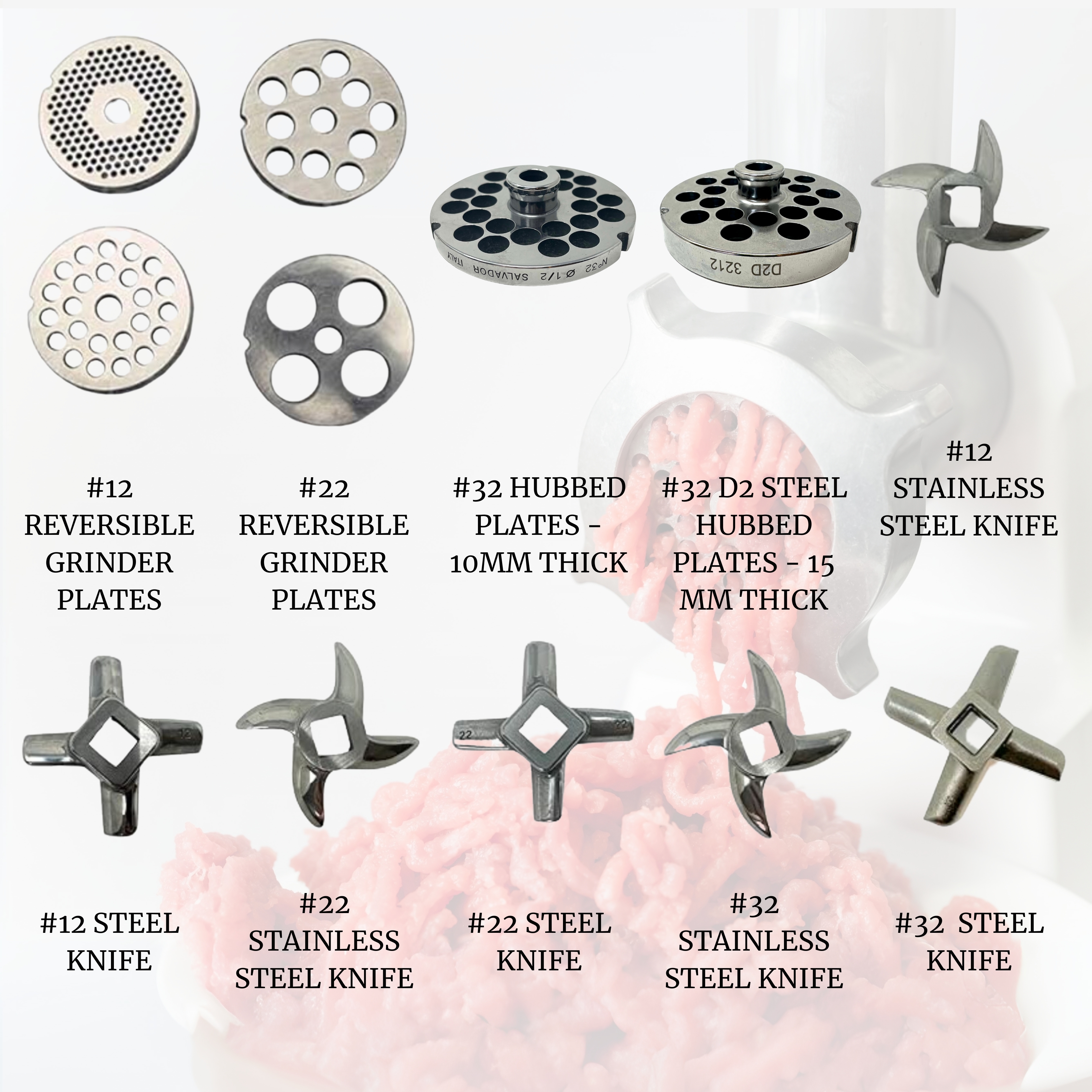
Understanding Meat Grinder Sizes — #8, #12, #22, and #32
Commercial meat grinders are categorized by size number — most commonly #8, #12, #22, and #32. The size number refers to the diameter of the grinder head opening and determines which plates, knives, and washers are compatible with your machine. Parts are not interchangeable between sizes — a #22 plate will not fit a #32 grinder and vice versa. Always confirm your grinder's size before ordering replacement parts.
The #12 grinder is the most common size for light commercial and retail butcher shop use. The #22 is the standard workhorse in most commercial butcher shops and meat processing operations. The #32 is used in high-volume industrial settings where throughput is the priority. If you are unsure of your machine's size, check the label on the back or side of the grinder, consult your machine's manual, or contact CutleryMania at (973) 287-6535 — we can identify the correct parts for your specific machine.
Check out our Meat Grinder Plate and Knife Size Guide
Shop by grinder size: #12 Knives and Plates | #22 Knives and Plates | #32 Knives and Plates
Which Plates and Knives Fit My Grinder?
Meat grinder replacement parts are sized by grinder number — #12, #22, and #32 are the most common sizes for home and commercial use. Find your brand and model below to confirm which size parts you need.
#12 Grinders — commonly found in: LEM Products #12 series · Cabela's 1/2 HP and 3/4 HP grinders · STX Turboforce II and similar entry-level commercial models · Weston Pro Series #12 · Kitchener #12 models · Hobart 612, 4212, 4312, 4412, 4812 · Biro 812 · Butcher Boy TCA12 · Globe-Stimpson 5412, 5511 · Toledo 5216 · Torrey 12
#22 Grinders — commonly found in: LEM Products #22 series · Cabela's 1 HP and 1.5 HP grinders · STX Megaforce and Turboforce #22 · Weston Pro Series #22 · Kitchener #22 models · Hobart 622, 4222, 4322, 4722, 4822 · Biro 822, 922, 6622 · Butcher Boy TCA22 · Globe-Stimpson 2522, 5522, 5622 · Hollymatic 22S · Toledo 5220, 5221, 5222 · Torrey 22
#32 Grinders — commonly found in: LEM Products #32 series · Cabela's heavy duty 2 HP+ models · Weston Pro Series #32 · Hobart 4532, 4542, 4632, 4732 · Biro 342, 346, 542, 548 · Butcher Boy A42, B42, TCA32 · Hollymatic 32S · Toledo 5326, 5320, 5321 · Torrey 32 · Globe-Stimpson 5932, 6142
Not sure which size you have? Measure your existing plate diameter — #12 is approximately 2-3/4 inches, #22 is approximately 3-1/4 inches, #32 is approximately 3-7/8 inches. Still not sure? Call or text us at (973) 287-6535.
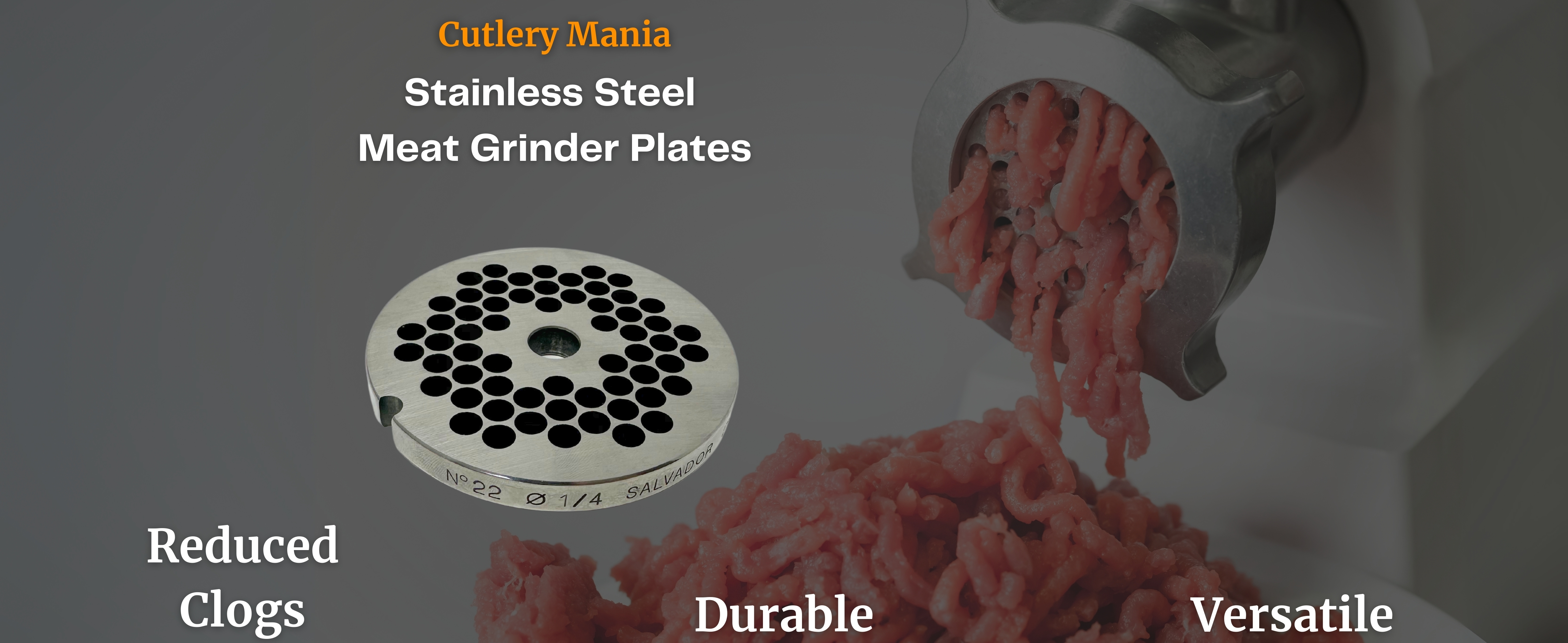
Meat Grinder Plate Hole Sizes — Which Size Should You Use?
The grinder plate (also called a grinder disc or grinder die) is the perforated stainless steel disc that determines the coarseness of your grind. The plate works together with the grinder knife to cut meat as it passes through the holes. Smaller holes produce a finer grind; larger holes produce a coarser grind. Choosing the right hole size depends on the end product you are making.
1/8 Inch Grinder Plate — Fine Grind
A 1/8 inch grinder plate produces the finest grind available in standard commercial applications. Meat ground through a 1/8 inch plate has a smooth, uniform texture with very little visible grain. This makes it ideal for hot dogs, emulsified sausage, breakfast sausage, pâtés, and any product where a tight, consistent emulsion is required. Many butchers use a 1/8 inch plate as a second-pass plate — grinding first through a coarser plate, then finishing through 1/8 inch for a smoother final texture.
9/64 Inch Grinder Plate — Fine-Medium Specialty Grind
The 9/64 inch plate sits between the 1/8 inch and 3/16 inch sizes and is a specialty plate favored by experienced sausage makers who need more control over grind consistency than a standard 3/16 inch plate provides. It produces an extra fine, uniform grind ideal for emulsified sausage, frankfurters, hot dogs, and pâtés where the finest possible texture is required. If your operation makes emulsified products and the 3/16 inch plate produces a texture that is slightly too coarse, the 9/64 inch plate bridges the gap without going all the way to a 1/8 inch grind.
3/16 Inch Grinder Plate — Medium-Fine Grind
The 3/16 inch grinder plate is the most widely used plate size in commercial butcher shops and meat processing operations. It produces the standard grind texture most buyers recognize as regular ground beef — firm enough to hold together for burgers and meatballs, but with enough texture to avoid the paste-like consistency of a fine grind. If you only stock one plate size for everyday use, 3/16 inch is the right choice for standard hamburger, mixed meat blends, meatloaf, and general-purpose butcher shop grinding.
1/4 Inch Grinder Plate — Medium Grind
A 1/4 inch grinder plate produces a noticeably coarser grind than 3/16 inch, with more visible meat texture and a chunkier bite. This is the preferred plate for coarse burgers, chili meat, rustic farm-style sausage, and any application where a heartier, more textured grind is the goal. The 1/4 inch plate also works well as a first-pass plate when processing tougher cuts — grinding first through 1/4 inch reduces the load on the grinder motor before a second, finer pass.
Need a complete #22 replacement kit?
Our #22 Meat Grinder Bundle includes both the 3/16" and 1/4" grinding plates plus a steel blade — everything you need to restore your #22 grinder to like-new performance. Save 10% vs buying separately.
3/8 Inch Grinder Plate — Coarse Grind
A 3/8 inch grinder plate is the coarsest standard option and is used primarily for initial breakdown of large cuts, wild game processing, stew meat, and chili meat where a chunky texture is desired. Most operations use the 3/8 inch plate as a first-pass plate only — running tough or large cuts through it before finishing through a smaller plate. It is the best starting point for deer, elk, and other wild game where the first grind needs to handle sinew and connective tissue efficiently.
1/2 Inch Grinder Plate — Maximum Coarse Grind
The 1/2 inch plate produces the coarsest grind available in standard commercial configurations. It is used almost exclusively as a first-pass plate for initial breakdown of very large, tough cuts of beef, wild game, and pork before a second pass through a finer plate. At this coarseness level the output is more chunky pieces than ground meat — ideal for stew meat, bulk chili, and hunters processing large volumes of deer or elk who want maximum throughput on the first pass.
Can I Use Two Plates in One Grinding Process?
Yes — double-grinding is standard practice in commercial butcher shops and processing facilities. Many operations run meat through a coarser plate first (3/8 inch or 1/4 inch) to break it down, then run it through a finer plate (3/16 inch or 1/8 inch) for the final texture. Double-grinding improves consistency, reduces motor strain, and produces a cleaner, more uniform end product compared to trying to force tough cuts through a fine plate in a single pass.
| Plate Size | Grind Type | Best For |
|---|---|---|
| 9/64 inch | Fine-medium specialty | Frankfurters, emulsified sausage, and fine blends |
| 3/16 inch | Medium-fine | Standard burgers, meatballs, everyday ground beef — most versatile |
| 1/4 inch | Medium | Coarse burgers, chili meat, rustic sausage, first-pass grinding |
| 3/8 inch | Coarse | Wild game, stew meat, initial breakdown of large cuts |
| 1/2 inch | Maximum Coarse | Very large cuts, bulk wild game processing, first-pass only before finer grind |
Meat Grinder Knives — Stainless Steel vs Carbon Steel
The grinder knife (also called a grinder blade) is the four-pointed cross-shaped blade that sits directly against the grinder plate. As the auger pushes meat toward the plate, the knife rotates and cuts meat cleanly through the plate holes. The knife and plate wear together — when one becomes dull, the other typically needs replacement at the same time. Trying to pair a new knife with a worn plate (or vice versa) results in smearing rather than clean cutting.
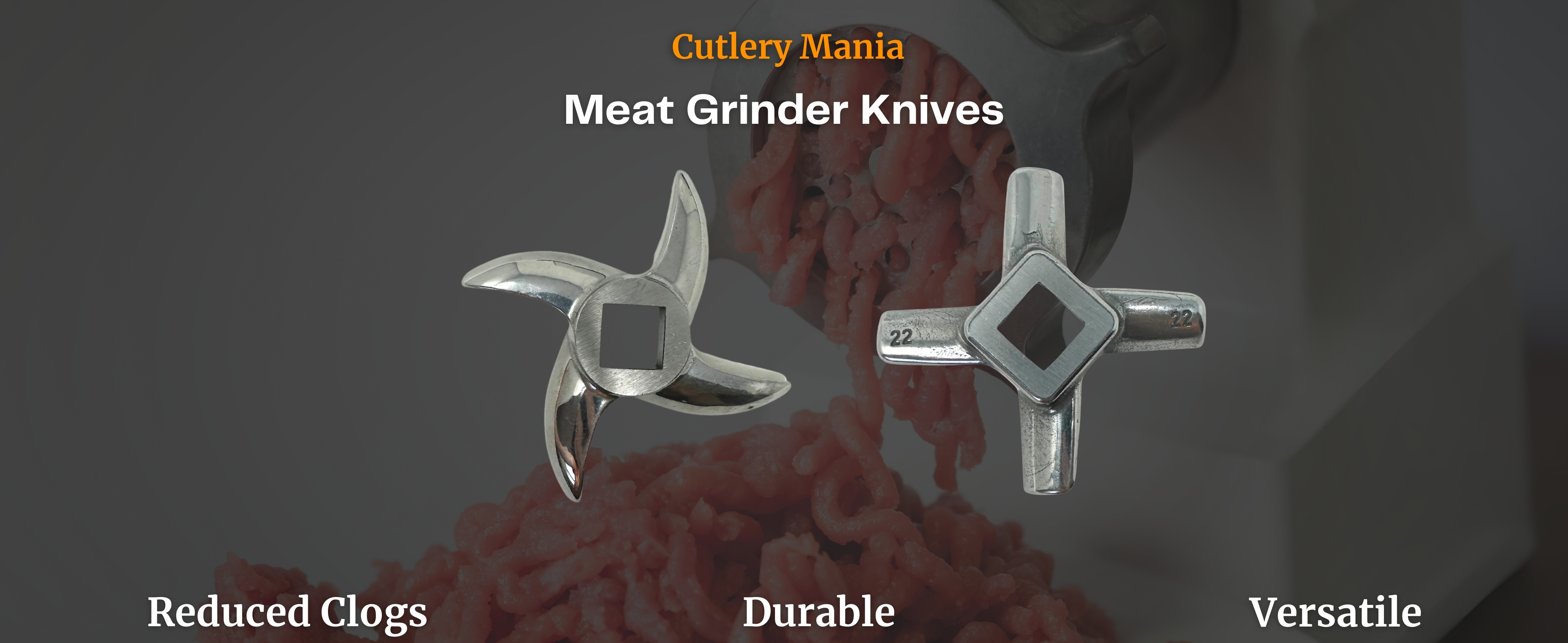
Stainless Steel Grinder Knives
Stainless steel grinder knives are the preferred choice for operations that prioritize hygiene, easy cleaning, and rust resistance. Stainless steel resists corrosion even in wet, high-moisture environments, making it the better material for seafood processing, high-turnover commercial kitchens, and any operation where blades are frequently sanitized with water and cleaning chemicals. The trade-off is that stainless steel is slightly softer than carbon steel, which means it may need to be replaced or sharpened more often under very heavy use.
Carbon Steel Grinder Knives
Carbon steel grinder knives hold a sharper edge longer than stainless steel and deliver more aggressive cutting performance under heavy continuous use. This makes carbon steel the preferred choice for high-volume butcher shops, industrial meat processing, and operations where maximum throughput and cutting efficiency are the priority. The trade-off is that carbon steel is more prone to rust if not properly cleaned and dried after each use — in a wet or poorly maintained environment, stainless steel is the safer choice.
D2 Steel Grinder Plates — Maximum Commercial Performance
For the highest-volume commercial operations where standard stainless steel plates wear too quickly, CutleryMania carries hubbed D2 tool steel plates for #32 grinders. D2 is a high-carbon, high-chromium tool steel used in professional-grade cutting tools and industrial blades — significantly harder and more wear resistant than standard stainless steel. D2 plates maintain a sharper cutting edge longer under sustained heavy grinding loads, can be resharpened when needed, and significantly extend the replacement interval in high-volume processing facilities. Available in the same hole sizes as standard stainless plates — 9/64" through 1/2". Note: D2 steel requires hand washing and thorough drying after use to prevent rust — it is not dishwasher safe.
Should I Replace the Knife and Plate Together?
Yes — in almost all cases, grinder knives and plates should be replaced at the same time. The knife and plate wear together over time, and a new knife pressed against a worn plate (or a new plate paired with a dull knife) will not seat properly, resulting in smearing, poor grind quality, and accelerated wear on the new part. Replacing both together ensures proper contact, clean cutting, and the longest possible service life from your new parts.
Meat Grinder Washers — Thrust Washers, Spacers & Bushings
The meat grinder washer (also called a thrust washer, grinder spacer, grinder bushing, or grinder gasket) is a small but critical component that sits between the worm auger and the cylinder housing inside the grinder head. It serves two functions: it prevents the back of the worm gear from grinding directly against the inside of the cylinder, and it ensures the grinding plate extends slightly beyond the end of the cylinder so that when the retaining ring is tightened, the knife and plate create a secure, tight fit. A worn or missing washer causes metal-on-metal wear, uneven grinding, and can lead to expensive damage to the grinder housing.
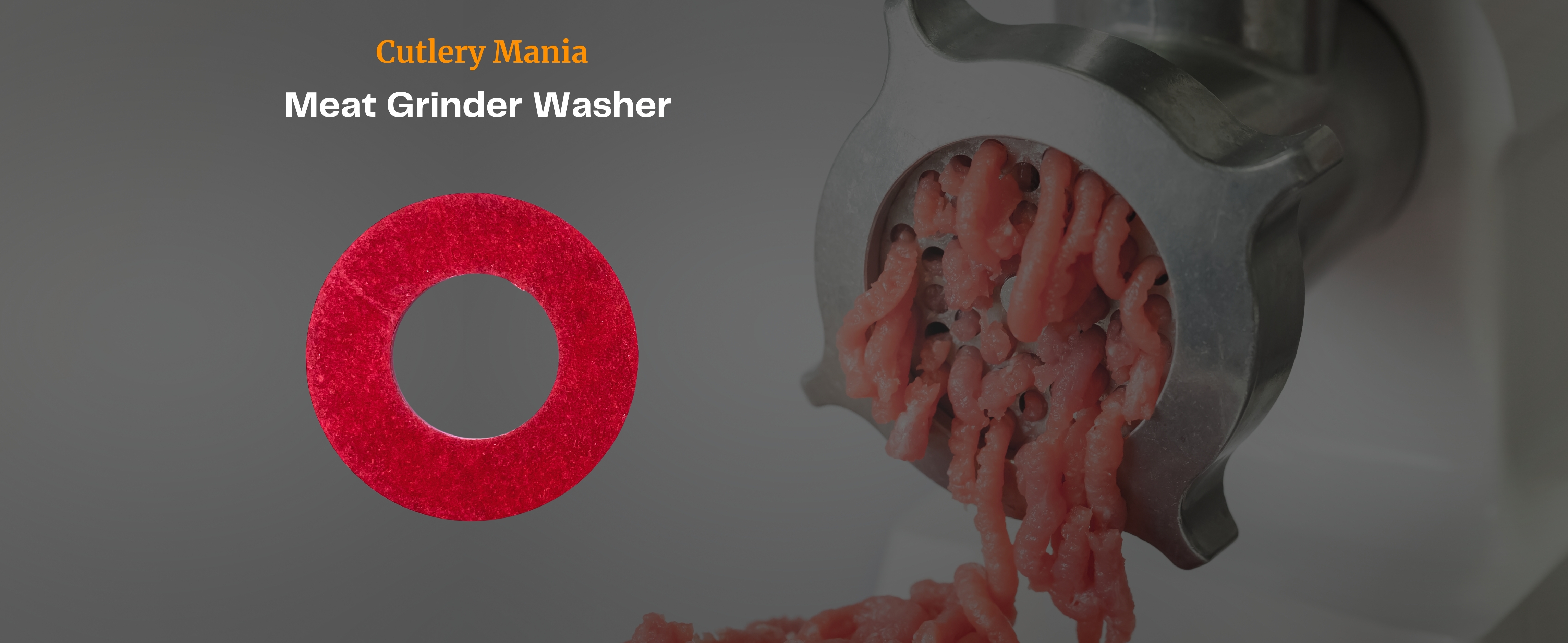
Fiber Grinder Washers
Fiber washers are the traditional standard for commercial meat grinders and are used in Hobart, Pro-Cut, Biro, Torrey, Avantco, and many other commercial grinder models. Fiber handles heat and friction well under continuous high-volume operation, making it the preferred material for butcher shops and meat processing facilities that run their grinders hard every day. Fiber washers can become brittle or compressed over time and should be replaced if cracked, flattened, or worn thin.
Nylon and Plastic Grinder Washers
Nylon and food-grade plastic washers offer slightly higher moisture resistance than fiber and are common in lighter commercial and home grinder applications. They reduce metal-on-metal contact effectively and are an inexpensive replacement part for routine grinder maintenance. Under very heavy continuous commercial use, nylon washers may wear faster than fiber — in high-volume operations, fiber is typically the longer-lasting choice.
Signs Your Grinder Washer Needs Replacement
Replace your grinder washer if you hear metal scraping or grinding noise during operation, notice excess auger movement or wobble, experience uneven grinding performance, or see visible wear, cracking, or compression on the washer itself. Ignoring a worn washer causes the worm gear to wear down the inside of the cylinder housing — a much more expensive repair than replacing a washer. In high-volume operations, many shops replace washers as part of routine preventive maintenance regardless of visible wear.
Meat Grinder Sausage Stuffing Tubes
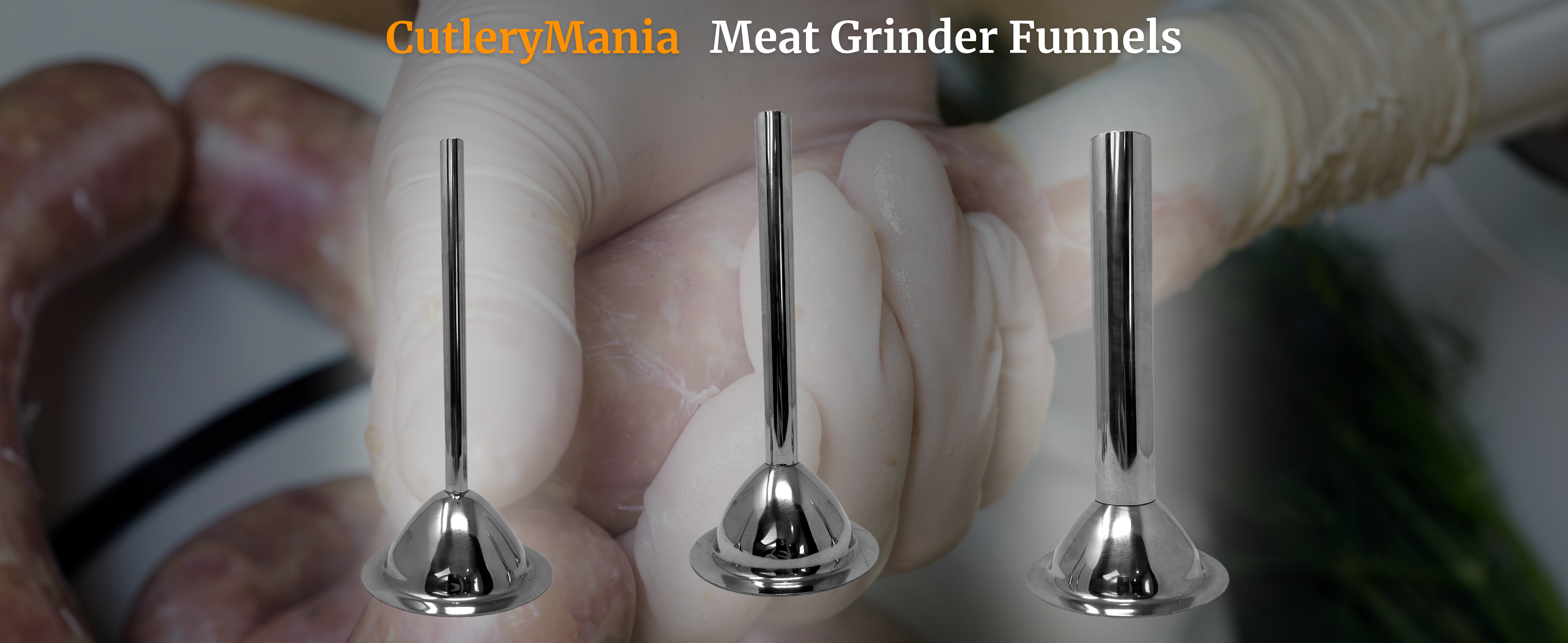
Sausage stuffing tubes (also called stuffing tubes or sausage tubes) attach to the front of a meat grinder in place of the grinder plate to allow the grinder to fill sausage casings. The tube diameter determines which casing size it works with — using the wrong tube size for a casing results in blowouts, uneven fills, or difficulty threading the casing onto the tube. Most commercial grinders accept multiple stuffing tube sizes, and stuffing tube sets typically include small, medium, and large tubes to cover the full range of sausage types.
Small Stuffing Tubes (10mm–20mm) — Snack Sticks and Breakfast Sausage
Small diameter stuffing tubes in the 10mm–20mm range are used for snack sticks, breakfast sausage links, hot dogs, and other thin sausage products stuffed into sheep casings or narrow collagen casings. The narrow tube provides better control for small-diameter casings and reduces the risk of casing blowouts that occur when too much pressure is applied through an oversized tube.
Medium Stuffing Tubes (20mm–30mm) — Bratwurst and Italian Sausage
Medium stuffing tubes in the 20mm–30mm range are the most versatile and commonly used size for standard sausage production. They work with natural hog casings and standard collagen casings for bratwurst, Italian sausage, Polish sausage, and other retail sausage products. If you only purchase one tube size, a medium tube covers the widest range of everyday sausage making applications.
Large Stuffing Tubes (30mm+) — Summer Sausage and Salami
Large tubes above 30mm are used for summer sausage, bologna, salami, and other large-diameter sausage products stuffed into fibrous or large natural casings. The wider tube reduces air pockets during stuffing and allows faster filling of large-diameter casings in bulk production environments.
Stainless Steel vs Plastic Sausage Stuffing Tubes
Stainless steel stuffing tubes are the better choice for commercial operations — they are more durable, easier to sanitize, resist cracking under heavy use, and will outlast plastic stuffing tubes many times over in a high-volume butcher shop or processing facility. Plastic stuffing tubes are more affordable and appropriate for home processing or light occasional use, but they can crack over time and are harder to keep fully sanitary in a commercial environment.
Shop Stainless Steel Sausage Stuffing Tubes →
Quick Meat Grinder Parts Selection Guide
| Application | Recommended Parts |
|---|---|
| Standard burgers and ground beef | 3/16" plate + stainless or carbon steel knife |
| Fine sausage and emulsified meats | 9/64" plate + stainless steel knife |
| Coarse chili meat and rustic sausage | 1/4" or 3/8" plate + carbon steel knife |
| Wild game processing | 3/8" plate (first pass) + 3/16" plate (finish) |
| High-volume commercial production | Carbon steel knife + fiber washer + matching plate |
| High-hygiene or wet environments | Stainless steel plate and knife + nylon washer |
| Bratwurst and Italian sausage stuffing | Medium stuffing tube (20mm–30mm), stainless steel |
| Snack sticks and breakfast links | Small stuffing tube (10mm–20mm), stainless steel |
Frequently Asked Questions — Meat Grinder Parts
What size grinder plate is best for burgers?
The 3/16 inch grinder plate is the most commonly used size for standard hamburger grind. It produces a medium-fine texture that holds together well for patties while maintaining enough grain to avoid a paste-like consistency. For a coarser, more rustic burger, some butchers prefer a 1/4 inch plate.
What grinder plate is best for sausage?
It depends on the sausage type. For fine emulsified sausage like hot dogs and breakfast sausage, a 9/64 inch plate produces the smoothest texture. For Italian sausage, bratwurst, and farm-style sausage, a 3/16 inch plate is the standard choice. For rustic or coarse sausage, a 1/4 inch plate adds more visible meat texture.
What is the difference between carbon steel and stainless steel grinder knives?
Carbon steel grinder knives hold a sharper edge longer and provide more aggressive cutting performance, making them the better choice for high-volume commercial use. Stainless steel knives are more resistant to rust and easier to maintain in wet or high-sanitation environments. Both are viable — the right choice depends on your usage volume and how well you maintain your equipment.
Should I replace the grinder knife and plate at the same time?
Yes. The grinder knife and plate wear together, and pairing a new part with a worn one results in poor contact, smearing instead of clean cutting, and faster wear on the new component. Replacing both at the same time ensures proper seating and the longest service life from your new parts.
What does a meat grinder washer do?
A meat grinder washer (also called a thrust washer, bushing, or spacer) sits between the worm auger and the cylinder housing. It prevents the worm gear from wearing down the inside of the grinder cylinder and ensures the grinding plate sits in the correct position so the knife and plate create a tight, secure fit when the retaining ring is tightened. A worn washer causes metal-on-metal wear, uneven grinding, and can damage the grinder housing if left unreplaced.
What is the difference between a fiber and nylon grinder washer?
Fiber washers handle heat and friction better under continuous heavy commercial use and are the traditional standard for most commercial grinder brands including Hobart, Pro-Cut, and Biro. Nylon washers offer better moisture resistance and are common in lighter commercial and home grinder applications. In high-volume operations, fiber typically lasts longer under sustained stress.
How do I know if my grinder washer needs to be replaced?
Replace your grinder washer if you hear metal scraping or grinding noise, notice the auger wobbling or moving unevenly, experience inconsistent grinding performance, or see visible cracking, compression, or wear on the washer. Many commercial operations replace washers as part of routine preventive maintenance to avoid damage to more expensive internal components.
Why is my ground meat smearing instead of cutting cleanly?
Smearing is almost always caused by one of three things: dull grinder knives or plates that are no longer cutting cleanly, meat that is too warm (cold meat grinds much cleaner than warm), or misaligned knife-to-plate contact. Replace the knife and plate together, keep your meat as cold as possible before grinding, and ensure the parts are properly seated and the retaining ring is fully tightened.
What grinder plate should I use for wild game processing?
For deer, elk, and other wild game, start with a 3/8 inch plate for the first grind to break down the meat and handle sinew efficiently. Then run it through a 3/16 inch plate for the final grind if a standard ground meat texture is the goal. Double-grinding wild game also helps improve the texture and removes any gamey quality from tough or fibrous cuts.
What size sausage stuffing tube should I use?
Match the stuffing tube to your casing size. Small stuffing tubes (10mm–20mm) work for snack sticks and breakfast sausage in sheep or narrow collagen casings. Medium stuffing tubes (20mm–30mm) are used for bratwurst, Italian sausage, and standard pork casings. Large stuffing tubes (30mm+) are for summer sausage, salami, and large fibrous casings. When in doubt, go slightly smaller — a stuffing tube that is too large causes casing blowouts.
Can I use my meat grinder as a sausage stuffer?
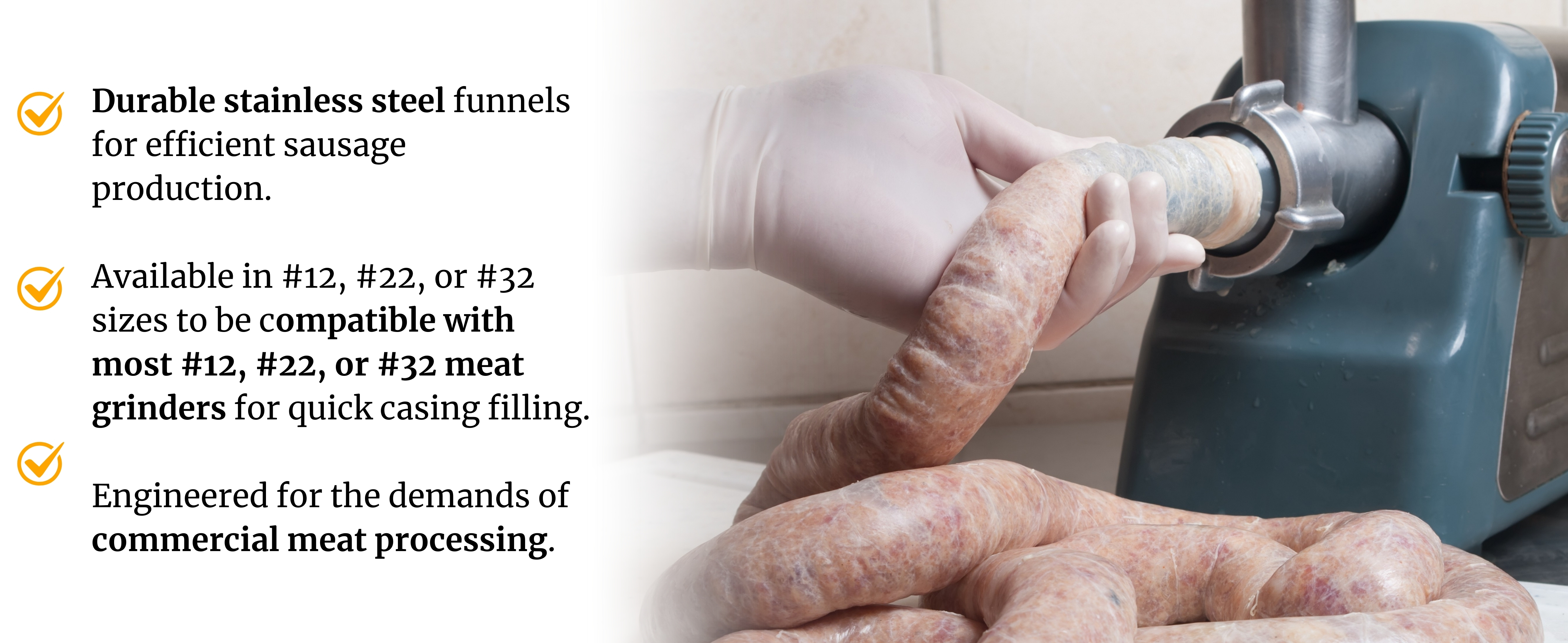
Yes. Most commercial meat grinders accept stuffing tubes or sausage tubes that replace the grinder plate. Remove the plate and knife, attach the stuffing tube to the grinder head, and feed the casing onto the tube before running the meat through. For very high-volume sausage production, a dedicated sausage stuffer is faster and gives more control, but a grinder with stuffing tubes is a practical option for moderate-volume use.
Why are my sausage casings bursting during stuffing?
Casing blowouts during stuffing are usually caused by using a stuffing tube that is too large for the casing diameter, overfilling (stuffing too tightly), stuffing too quickly without allowing the casing to stretch gradually, or using dry casings that have not been properly soaked and rinsed. Natural casings should be soaked in warm water before use to restore flexibility.
How do I know what grinder size I have — #12, #22, or #32?
For assistance, take a look at our Meat Grinder Plate and Knife Size Guide.
The grinder size is usually printed on a label on the back or side of the machine. You can also measure the plate diameter — a #12 plate is approximately 2-3/4 inches in diameter, a #22 plate is approximately 3-1/4 inches, and a #32 plate is approximately 3-7/8 inches. If you are still unsure, call or text CutleryMania at (973) 287-6535 — we can identify the right parts for your machine.
Shop Meat Grinder Parts by Size
CutleryMania carries replacement grinder plates, knives, washers, and stuffing tubes for #12, #22, and #32 commercial meat grinders. Compatible with Hobart, LEM, Pro-Cut, Weston, Avantco, Torrey, Cabela's, and other major commercial grinder brands.
- #12 Grinder Plates and Knives — Plates, knives, and accessories for #12 commercial meat grinders
- #22 Grinder Plates and Knives — Plates, knives, and accessories for #22 commercial meat grinders
- #32 Grinder Plates and Knives — Plates, knives, and accessories for #32 commercial meat grinders
- Meat Grinder Accessories — Washers, thrust washers, bushings, and stuffing tubes
Questions about which parts fit your machine? Call or text CutleryMania at (973) 287-6535 or email sales@cutlerymania.com. We respond within one hour during business hours.
There are no products listed under this category.